
Coaching for Life Transitions and Support Through Change

Support during a major change may need to be more focused than general life coaching. Coaching for life transitions centres on the uncertainty of moving from one chapter to another, helping you understand what is changing, recognise your strengths and decide what comes next.
If a career shift, relationship ending, relocation or other turning point has left you unsettled, it’s understandable to want space to process the change and a practical way forward. You don’t need to have every answer before seeking support.
This article explains what a life transition coach does, how coaching can support resilience and career decisions, and how transition coaching differs from broader life coaching. You’ll also learn what the process may involve and consider whether this support fits the change you’re facing.
Key Takeaways
- A transition coach helps you make sense of change, recognise your strengths and find practical next steps.
- Resilience can grow through self-compassion, supportive relationships and manageable actions.
- Noticing how change affects your thoughts, feelings and body can help you recognise when you need more support.
- At a career crossroads, coaching can help you clarify what matters and approach decisions with greater confidence.
- Broader life coaching supports personal development, while transition coaching focuses on the uncertainty and decisions involved in change.
What Is a Life Transition Coach?
A life transition coach helps you make sense of change and decide how to move forward. The work combines reflection with practical planning, while keeping your values and circumstances in view.
Career development through role and industry changes
A change in role, organisation or industry can unsettle your sense of direction, even when it brings opportunity. Coaching helps you reflect on your strengths, priorities and preferred working life, then consider how they fit your next move. Look for a coach who can help you explore both the practical career decision and its personal meaning, rather than steering you towards a predetermined answer.
To find a suitable coach in the United States or near you, use professional directories and local search terms related to transition coaching. Review their stated experience and approach, then consider whether their focus matches the change you’re facing.
Coping with career, family and personal change
A career shift can happen alongside family responsibilities, a relationship change or a move. A coach can help you separate these overlapping concerns, identify what needs attention first and build a plan that respects your capacity. The process should make room for emotional responses as well as decisions, so practical next steps reflect the reality of your personal life.
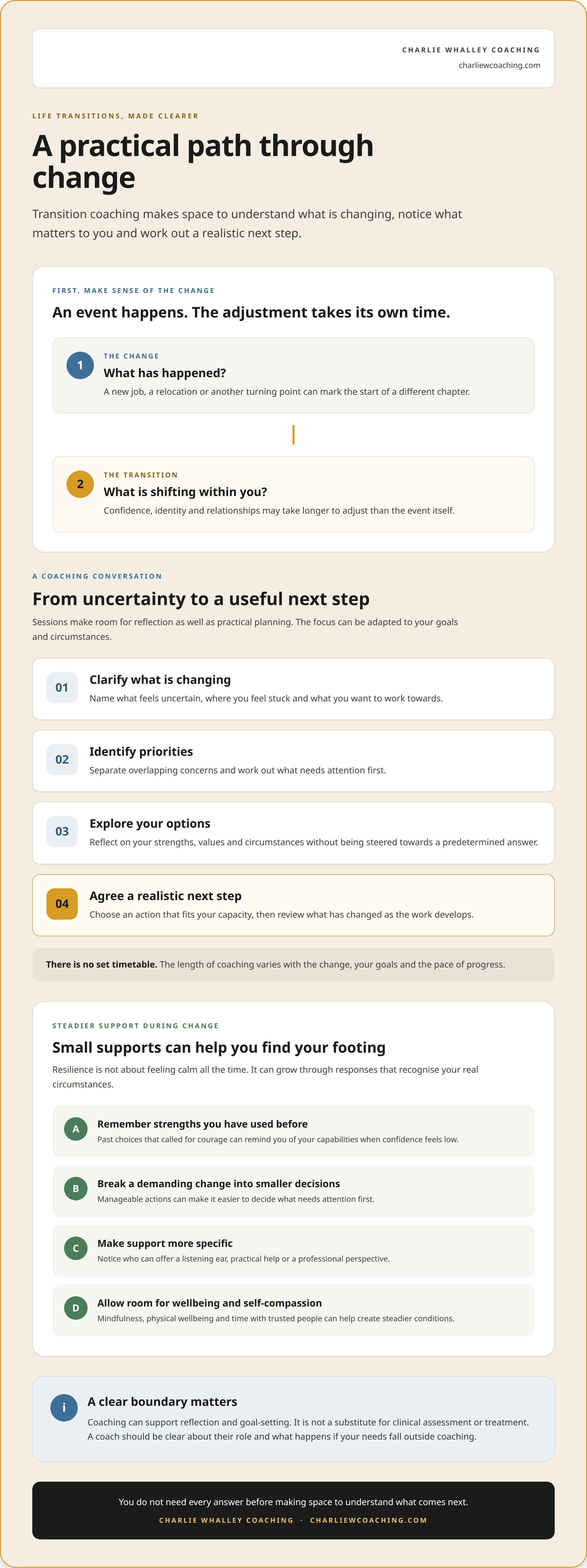
Coaching has limits: it supports reflection and goal-setting, but it isn’t a substitute for clinical assessment or treatment. Health insurance cover depends on the plan’s benefits and how the service is classified.
Understanding change and transition
Change is the event, such as starting a job or relocating; transition is the internal adjustment that follows. A coach can help you recognise what has ended, what feels uncertain and what you want to carry into the next chapter. This distinction matters because a new role may begin quickly, whilst confidence, identity and relationships can take longer to adjust.
When choosing a coach, look for relevant training, experience with transitions and clear boundaries around their role. Ask how sessions are tailored to your goals and what happens if your needs fall outside coaching. Credentials and relevant experience can help you assess the fit.
In the United States, coaching costs depend on the coach’s approach, session format and support offered; the fee is given after a quote request. There is no single credential that defines the right coach for every transition, so consider training alongside experience and fit.
Coaching sessions and duration
A session may begin by clarifying what is changing, where you feel stuck and what you want to work towards. The coach may help you identify priorities, explore options and agree on a useful next step. You bring your perspective and goals; the coach provides questions, structure and space to reflect.
The length of coaching varies with the change, your goals and the pace of progress. You can discuss the focus and review points as the work develops. There is no set timetable for every transition.
Building resilience and support networks
Resilience during change isn’t about feeling calm all the time. Coaching can help you recognise what feels overwhelming, draw on support and choose a manageable next step.
Building confidence and resilience
A coach can help you notice how you respond to setbacks and identify strengths you’ve used before. For example, after a divorce or difficult work change, you might reflect on a past decision that required courage. That experience can remind you of your capabilities, even when confidence feels low. The focus is on finding a response that fits your circumstances, not forcing positivity.
Support can also become more practical through specific goals. A coach might help you break a demanding transition into smaller decisions, such as clarifying which responsibilities need attention first. Mindfulness, self-compassion, physical wellbeing and time with trusted people can also support resilience. These aren’t quick fixes; they can help create steadier conditions for navigating change.
Developing support networks
A transition can affect your relationships as well as your routines. A new job may mean less time with colleagues, whilst a move can leave familiar friends further away. Coaching can help you identify who offers a listening ear, practical help or professional perspective, then consider how each relationship can support you. Naming these different forms of help makes your support network more useful.
A coach may help you map the people and communities already around you, including family, friends and workplace contacts. If a conversation feels difficult, you can explore what you want the other person to understand and how to express it clearly. This keeps connection relevant to your needs, rather than adding another obligation during an already demanding period.
Building a coaching practice also means creating a consistent space to reflect and review progress. Sessions can explore what has changed since the previous conversation, what remains difficult and which next step feels realistic. The coach adapts the focus to your circumstances, helping you maintain continuity without treating progress as a straight line.
A vision for the future can bring clarity when the next chapter feels uncertain. Rather than planning every detail, a coach may help you describe what matters in areas such as work, relationships and wellbeing. Those values can guide decisions, whether you’re considering a career shift or adjusting family routines. The result is a direction to explore, not pressure to have everything settled.
The emotional experience of major transitions
A major change can bring relief, grief, uncertainty or several feelings at once. Coaching can help you notice these responses and understand how they shape your next decisions.
Managing emotional highs and lows
A new role may feel exciting one day and unsettling the next, especially as routines and relationships shift. Rather than treating changing feelings as failure, a coach can help you identify what happened before a difficult moment and what helped you regain perspective. That reflection can reveal useful patterns.
For example, if a demanding work conversation leaves you anxious, you might explore what you feared, what you needed and what support would help. A coach can help you turn that reflection into a practical next step, such as preparing for a follow-up conversation or setting aside time to recover. The aim isn’t to suppress emotion, but to respond thoughtfully.
Recognising emotional phases
One way to understand a transition is through three phases: an ending, an in-between period and a new beginning. Leaving a familiar job may involve grieving the old routine, feeling uncertain before the next role is clear, then gradually developing confidence in a different environment. These phases describe a useful pattern, not a fixed timetable.
The journey may move back and forth. Someone starting a new role might feel settled until a change in responsibilities brings doubt again. A coach can help you reflect on which phase feels most present, what it asks of you and what meaning you’re making of the change. This can support emotional development without demanding constant progress.
It can help to name what is happening in specific terms. You might notice that uncertainty is affecting your concentration, or that a family change is bringing both sadness and relief. Identifying a stressor, noticing its emotional, physical or cognitive effects, and talking with someone you trust can make the experience easier to understand. Small observations matter.
Coaching offers a structured space to explore these observations and consider what resilience looks like in your circumstances. After a difficult week, for instance, you could review what drained your energy, what helped and what needs attention next. The focus stays on your experience and choices, rather than judging whether you should already feel ready for what comes next.
When stress becomes more noticeable, pause to distinguish possible causes from effects. Identify stressors connected with the transition, then notice whether stress shows up physically, emotionally or cognitively. Consider what has changed recently and which reactions seem connected to it, without assuming every difficult feeling has a single cause. Speaking with someone you trust can give you space to describe what you’re experiencing and what feels most pressing. You don’t have to resolve the transition immediately. These steps can help you understand what is affecting you and decide what support or attention would be useful now.
Career crossroads and meaningful work
A career crossroads can follow a promotion, redundancy, industry shift or return from parental leave. You may value your current work yet feel ready for a different direction. Coaching can help you examine what is changing and make career decisions that reflect your abilities, values and sense of purpose.
Start by separating the problem from the decision. If a new manager has changed your role, for example, consider whether the difficulty lies in the responsibilities, the workplace relationship or the wider organisation. A coach can help you reflect on what you want to preserve and what you’d like to change. This prevents one frustrating situation from defining every future option.
Next, explore what meaningful work means in your circumstances. It might involve using a particular ability, having more autonomy, contributing to a cause or creating a better balance with family life. A coach can help turn broad hopes into criteria for considering roles. If flexibility matters, for instance, weigh it alongside responsibilities, culture and development opportunities.
Career decisions often involve more than choosing between staying and leaving. You might explore an internal move, further training, a gradual change in responsibilities or a move into another industry. Coaching can help you assess each path against your priorities, identify missing information and consider the consequences for your current commitments. The aim is a considered decision, not an impulsive escape from discomfort.
Retirement can bring a different kind of career crossroads. You may be deciding whether to stop working, continue in a different capacity or give more time to interests outside employment. A coach can help you examine what work has provided, such as structure, connection or identity, and consider how those needs might be met in the next chapter. That reflection can make the decision more personal and grounded.
Once a direction begins to emerge, coaching can help turn it into a practical plan. This might include identifying skills to build, preparing for workplace conversations or setting out steps towards a role change. A coach can help you review progress and adjust the plan as circumstances shift. You remain the decision-maker; the coach brings structure to your thinking.
When considering a coach for career decisions, look for an approach that makes room for both purpose and practical realities. A useful conversation should help you explore your abilities and options without assuming that promotion, a new industry or retirement is automatically the right answer. The best direction is one that connects with your priorities.
Life coaching compared with transition coaching
Both approaches help you reflect, set goals and make decisions, but their starting points differ. Life coaching often explores broader personal development, whilst transition coaching centres on a specific period of change. The distinction matters if you’re choosing support during a new chapter and want the conversations to match your immediate needs.
Life coaching can suit someone who wants to strengthen confidence, clarify priorities or create a more satisfying balance. For example, you may want to make more room for creativity without facing one defining event. Sessions can explore what matters across work, relationships and wellbeing, then help you choose goals that guide your ongoing development.
Transition coaching takes a closer look at a particular change and its consequences. If you’ve accepted a new role, relocated or begun adjusting to retirement, a coach can help you work through uncertainty around that moment. Conversations may focus on what’s ending, what feels unsettled and what you need to move forward. The change itself provides a practical focus.
The approaches can overlap. Someone leaving a long-term job might use transition coaching to consider immediate decisions, such as approaching a handover or settling into a new team. Broader life coaching may also help explore what this career chapter means for identity, purpose and relationships. The emphasis depends on your goals, not a rigid boundary between labels.
To decide which focus fits, consider what you most want help with now. If you’re seeking direction across several areas, broader personal-development coaching may be a natural starting point. If a specific change is affecting your choices, confidence or routines, a transition-focused approach can keep attention on that experience. A coach should explain how sessions connect your priorities with practical next steps.
Someone returning to work after a major family change, for instance, may need to weigh immediate work arrangements against longer-term ambitions. A transition focus can help organise decisions around the return; broader coaching can explore how work fits into the life they want overall. You don’t need to settle on a label first. Begin with the change or goal you want to discuss.
If you’re weighing these approaches, explore coaching support and consider which focus best reflects the chapter you’re in.
Charlie Whalley Coaching: Life & Leadership Coaching
Charlie Whalley Coaching offers Life & Leadership Coaching and Career Transition Coaching for people facing personal or professional change. If uncertainty is making it difficult to trust your abilities or choose a direction, coaching can give you space to reflect, build confidence and consider practical next steps. The focus is on your circumstances and priorities, helping you move towards change with greater clarity rather than pressure to have every answer immediately.
If you’re ready to explore what support could look like, book a discovery call with Charlie Whalley Coaching.
Make space for your next step
You don’t need a complete plan before beginning. Sometimes the useful first step is naming what feels difficult, what you want to protect and what you’re ready to explore. Coaching for life transitions can help turn that reflection into a direction connected to your values and circumstances.
If a change is affecting your work, confidence or family life, Charlie Whalley Coaching offers a space to explore what support could look like. Its Kids Coaching may also help when a child is facing change and needs age-appropriate support to build resilience and self-confidence.
Contact Charlie Whalley Coaching to discuss your next step. You can move forward at a pace that feels right for you.
Frequently Asked Questions
Is this coaching or therapy?
Life transition coaching is coaching, not clinical psychotherapy. It focuses on your goals, choices and practical steps during change, rather than providing clinical mental health treatment. Charlie Whalley Coaching’s coach holds ICF credentials and follows the ICF Code of Ethics. Coaching depends on mutual chemistry and your active participation; if the fit isn’t right or the coach can’t add meaningful value, a referral elsewhere may be appropriate.
What if I feel stuck or uncertain about what I want?
You can begin coaching without a fully formed goal. Start by describing a recent moment when you felt stuck, such as putting off a conversation about changing roles. A coach can help you explore what feels difficult, what matters to you and what you’d like to be different. You don’t need to choose a direction immediately; forming a clearer question can be a useful first step.
What is life transition coaching?
Coaching for life transitions is a focused partnership for working through a significant change and deciding how to respond. If you’re returning to work after time away, for example, sessions could explore what you need from your working life and what decisions lie ahead. The coach offers questions and structure; you bring your experience, make your own choices and put agreed actions into practice.
What life transitions can a coach help with?
A coach can support reflection on changes such as relocation, a relationship ending, new parenthood, retirement or a career shift. You might weigh a move for work against family commitments, for example. Coaching helps you consider the choices and priorities involved, then identify a direction that fits your situation. The focus comes from the change you’re facing and what you want to work towards.
How does life transition coaching compare with therapy or career counselling?
Life transition coaching focuses on personal goals, decisions and forward movement during change. Therapy addresses clinical mental health needs, so coaching isn’t a replacement when you need clinical care. Career counselling typically centres on career questions, whilst transition coaching can also consider how a work change affects confidence, relationships or identity. For a career shift, Charlie Whalley Coaching’s Career Transition Coaching helps align strengths and values with career direction.
How much does life transition coaching cost in the U.S.?
Costs vary by coach, session format and support, and the fee is provided after a quote request.